
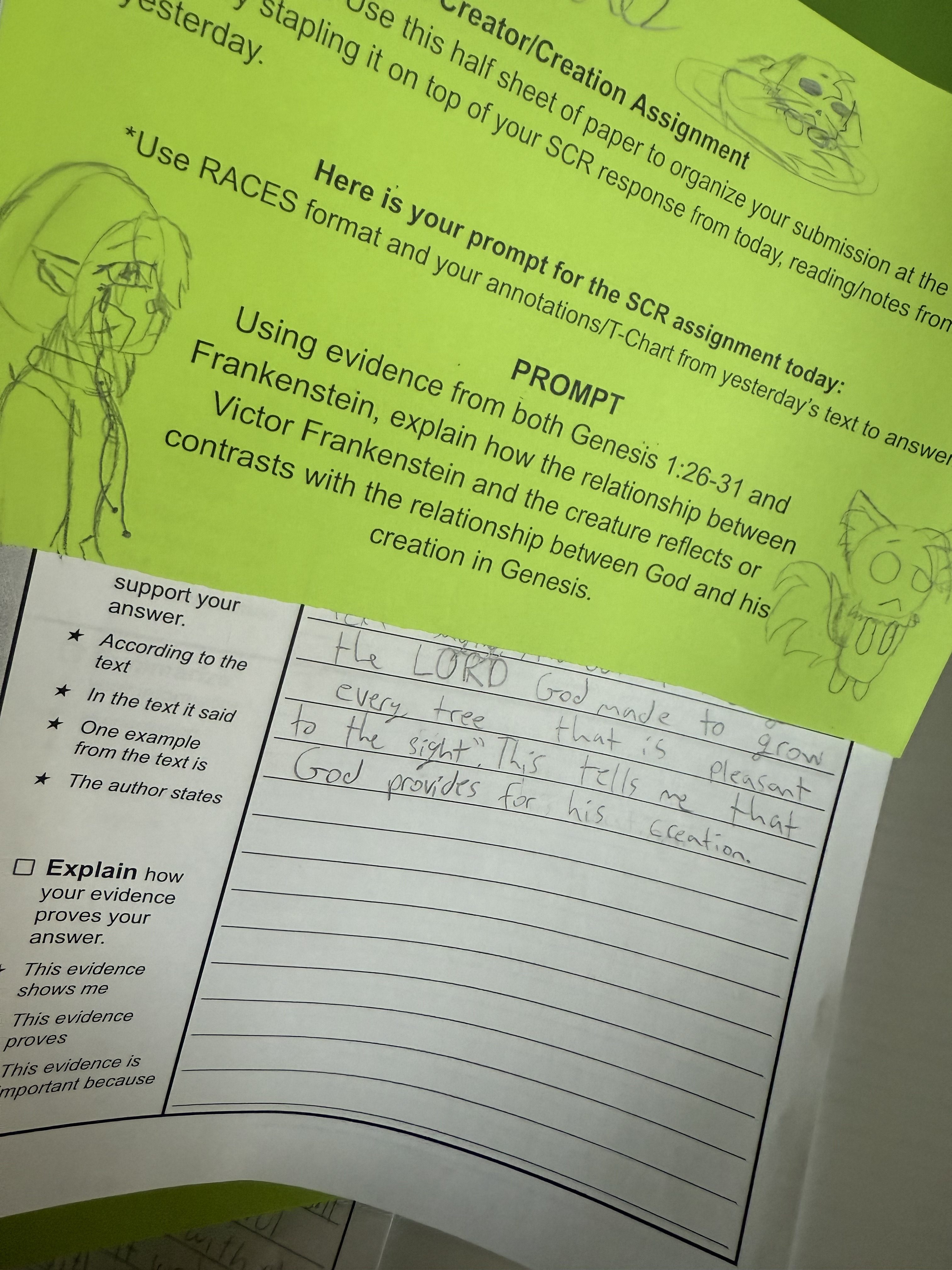
Here’s the thing about Frankenstein in AP Literature: your students probably already know the story. Maybe they met it in seventh grade, maybe through a graphic novel, maybe through a Halloween costume with bolts in its neck. Creator and creation is the part everyone carries in with them.
That’s your advantage. You don’t have to spend senior year on what happens. You get to spend it on how the book makes meaning: the framed narratives, the borrowed scripture, the question of who gets to tell whose story. This is where you sophisticate.
You don’t need to close read the whole novel to get there. You need the right three passages. These are the ones I’d build a unit around.
1. The Creation Scene (Volume I, Chapter 5)
“I had desired it with an ardour that far exceeded moderation; but now that I had finished, the beauty of the dream vanished, and breathless horror and disgust filled my heart.”
Start here, because this is where Victor fails as a reader of his own work. Look at the hinge in the sentence: everything before the semicolon is desire, everything after is revulsion, and nothing in between is the creature itself. Victor is reacting to the gap between his dream and his result, not to the being in front of him. Just before this, he says he had selected the creature’s features “as beautiful,” then breaks off: “Beautiful!—Great God!” The creature hasn’t done anything yet. It has only opened “the dull yellow eye.” Ask students what, exactly, Victor is horrified by, and they’ll discover that the evidence against the creature comes from Victor’s aesthetic disappointment. This is the first case in the novel of judging by appearance, and it is the creator, not society, who does it first. Everything the creature later suffers from strangers, he suffered first from his maker.
2. The Creature’s Plea (Volume II, Chapter 2)
“Remember, that I am thy creature; I ought to be thy Adam; but I am rather the fallen angel, whom thou drivest from joy for no misdeed… I was benevolent and good; misery made me a fiend. Make me happy, and I shall again be virtuous.”
This is the passage that rearranges the moral argument of the book. Students expect a monster to growl and instead get the most controlled rhetoric in the novel. Have them track the pronouns first: the archaic “thy” and “thou” put Victor in God’s position, and the creature knows it. Then the allusion does the heavier lifting. Through Paradise Lost, the creature casts himself as two figures at once: the Adam he was supposed to be and the Satan he has been made into. The accusation is that the fall was the creator’s doing, not the creature’s choice. Finally, look at the logic of “misery made me a fiend.” It’s a causal argument, and a conditional one: make me happy, and I will be virtuous again. Ask students whether they believe him. Then ask what it means that the most persuasive speaker in the novel is the one nobody will look at. This is a natural place for a timed writing prompt, because students have to weigh eloquence against action.
3. The Final Disappearance (Walton’s Final Letter)
“He sprung from the cabin-window as he said this, upon the ice-raft which lay close to the vessel. He was soon borne away by the waves, and lost in darkness and distance.”
End with the frame, because this is the senior-year story. By the last page, students have heard the creature speak through Victor, and Victor speak through Walton, and Walton write to a sister who never answers. So who is actually telling us that the creature leaves? Walton, who is our only witness. Point out what the passage refuses to do: we never see the funeral pile the creature promised, where he said he would “exult in the agony of the torturing flames.” We only see him leave the frame. The creature is literally carried out of the narrative into “darkness and distance,” which is exactly where the text has kept him all along. Ask students whether this is an ending or an evasion. Then ask them to reread Walton’s opening letters, where he also dreams of glory at any cost. They’ll realize the frame isn’t a wrapper around the story. It’s a third version of it: another ambitious man who, unlike Victor, turns back.
Why These Three
Together, these passages trace the book’s whole argument. The creation scene shows the creator’s failure. The plea shows the creation’s case. The ending shows the frame that decides whose version survives. Teach them in that order and your students will move from character to rhetoric to structure, which is the same progression the AP exam rewards.
They also connect back to whatever students brought in with them. The creator-and-creation story they met at twelve is still there. Now they can see the machinery underneath it.
Want the Full Close Reading?
My AP Literature Frankenstein resource takes each of these passages further, with annotated excerpts, guided discussion questions, AP-style prompts, and the full sequence I use to move students from what happens to how it’s built. If these three paragraphs gave you a lesson, the resource gives you the unit.
[Get the Frankenstein AP Literature Close Reading resource on TPT →] [LINK]
Leave a Reply